
Crypto Funding Rates Study
Available to ALL subscribers | Analyzing the Crypto market's appetite for risk by measuring its favorite trading instrument

Perpetual swaps are one of the most popular products to come out of crypto.
This product alone has king made many companies, including Bitmex, Binance, Bybit, etc.
Today we are going to zoom in on funding rates for perpetual swaps, the core mechanic to keep this derivatives product tethered to the price of the underlying asset.
For those that are less familiar with funding rates, they function and incentivize traders as follows:
High funding rate (Positive)
Perpetual swap price > Spot price
Buyers of perpetual swaps pay interest (i.e. the funding rate) to sellers
Design is to incentivize more traders to take the short side, in order to bring the perpetual swap price closer back to the underlying spot price
Low funding rate (Negative)
Perpetual swap price < Spot price
Sellers of perpetual swaps pay interest (i.e. the funding rate) to buyers
Design is to incentivize more traders to take the long side, in order to bring the perpetual swap price closer back to the underlying spot price
Within we are going to explore multiple new angles to measuring funding rates and what they tell us about Crypto markets.
Some people say there’s not much signal in funding rate data - today we put that to the test.
LETS. GO.
TLDR
Altcoins pump when funding rates are elevated.
Perps with the highest funding rates are the “biggest bulls”, and can let us know if the market has a non existent appetite for risk.
Negative funding rates are relatively normal for altcoins.
Negative funding rates are rare for BTC.
Perp pairs with more in open interest tend to have larger spikes upwards and downwards in funding, making them more expensive to trade.
% of days with negative funding can be a very helpful way to understand how persistently shorted any asset or market is.
Tracking BTC’s funding % rank vs other perpetual swap pairs can also help people gauge how bullish / bearish the market is (BTC low rank = Bear | BTC high rank = Bull).
VIDEO VERSION OF ARTICLE (31 MIN)
THE PUMP
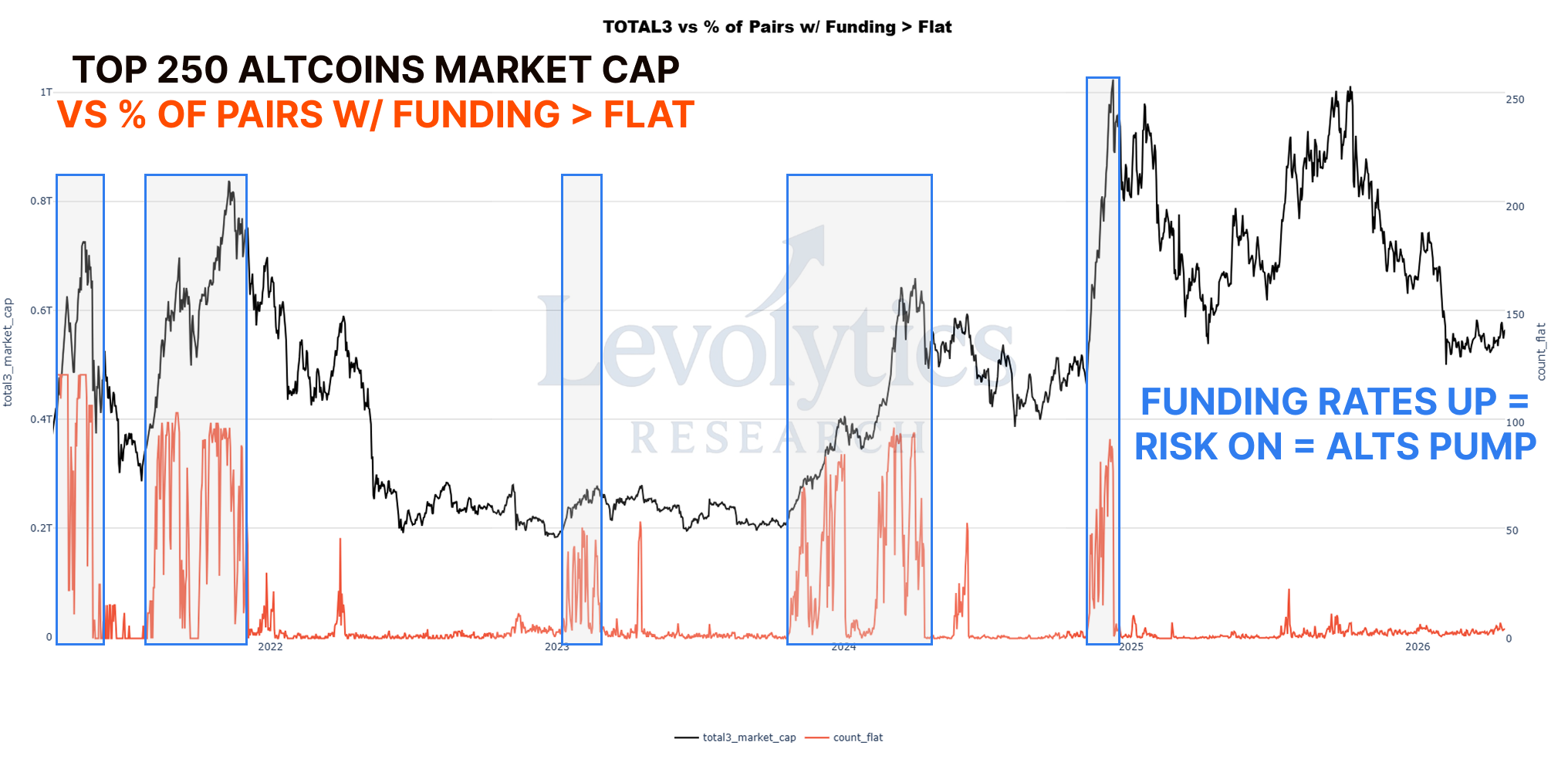
Exchanges set a default “flat” value for funding rates - the standard value is 0.01% paid from longs to shorts every 8 hours.
This value annualizes to ~11%, and a level that is worth tracking for funding rates.
In the case of the chart above, we track the % of perpetual swap pairs that have a funding rate greater than the default 11% annualized.
By doing this, we can gauge the market’s widespread appetite for risk.
Large % of pairs with funding greater than flat indicates to us that traders are excited to get long.
Note that we have this metric plotted versus the top 250 altcoins market cap, and this is no accident - as altcoin performance is another way we can gauge the market’s appetite for risk.
The chart indicates to us the following: most significant pumps that result in new highs for altcoins occur with elevated funding rates.
Sustained altcoin pumps go hand in hand with high funding rates.
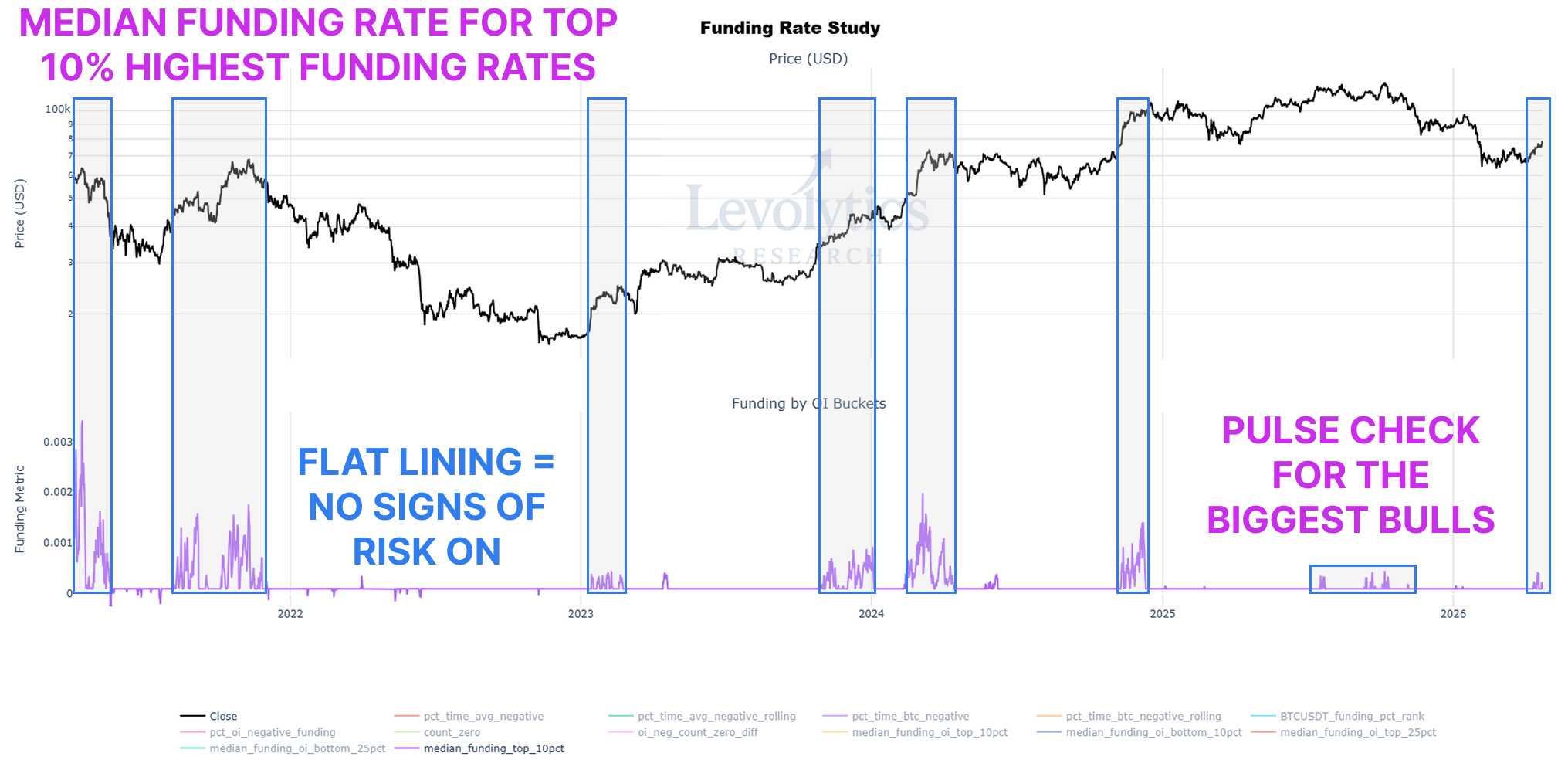
Another way to see how bulled up traders are is by tracking the top 10% of pairs with the highest funding rates.
This cohort consists of the biggest bulls in the market at any given time.
If the value for this metric is ever flat or anything below it, then that is a very strong signal that the market doesn’t have much appetite to get long.
If the biggest bulls aren’t even trying to ape, then why should we?
THE NORM
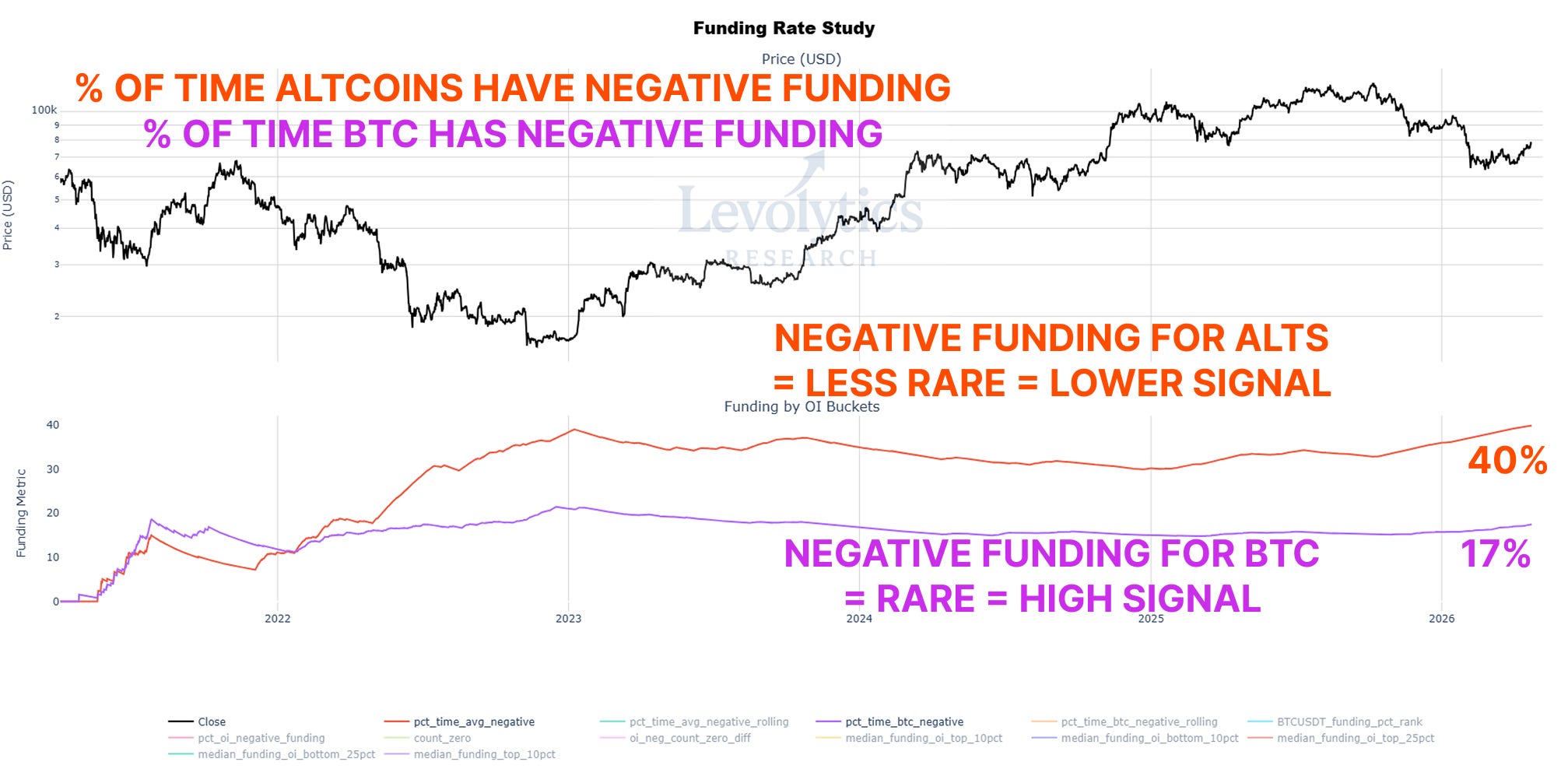
We’ve pulse checked the bulls and now it’s time to check the market’s resting heart rate.
If we understand what the normal is for Crypto markets, we won’t get excited for the wrong reasons in the future.
In the case of altcoins, negative funding rates are borderline “normal” - with 40% of their time trading with shorts paying longs.
This is likely a large result of their consistently poor price action between 2021 and now.
Nonetheless, negative funding rates alone are not sufficient reason to get excited about longing altcoins - it’s context dependent.
On the other hand - negative funding for BTC is rare and should be respected when it occurs, with only a 17% occurrence over time.
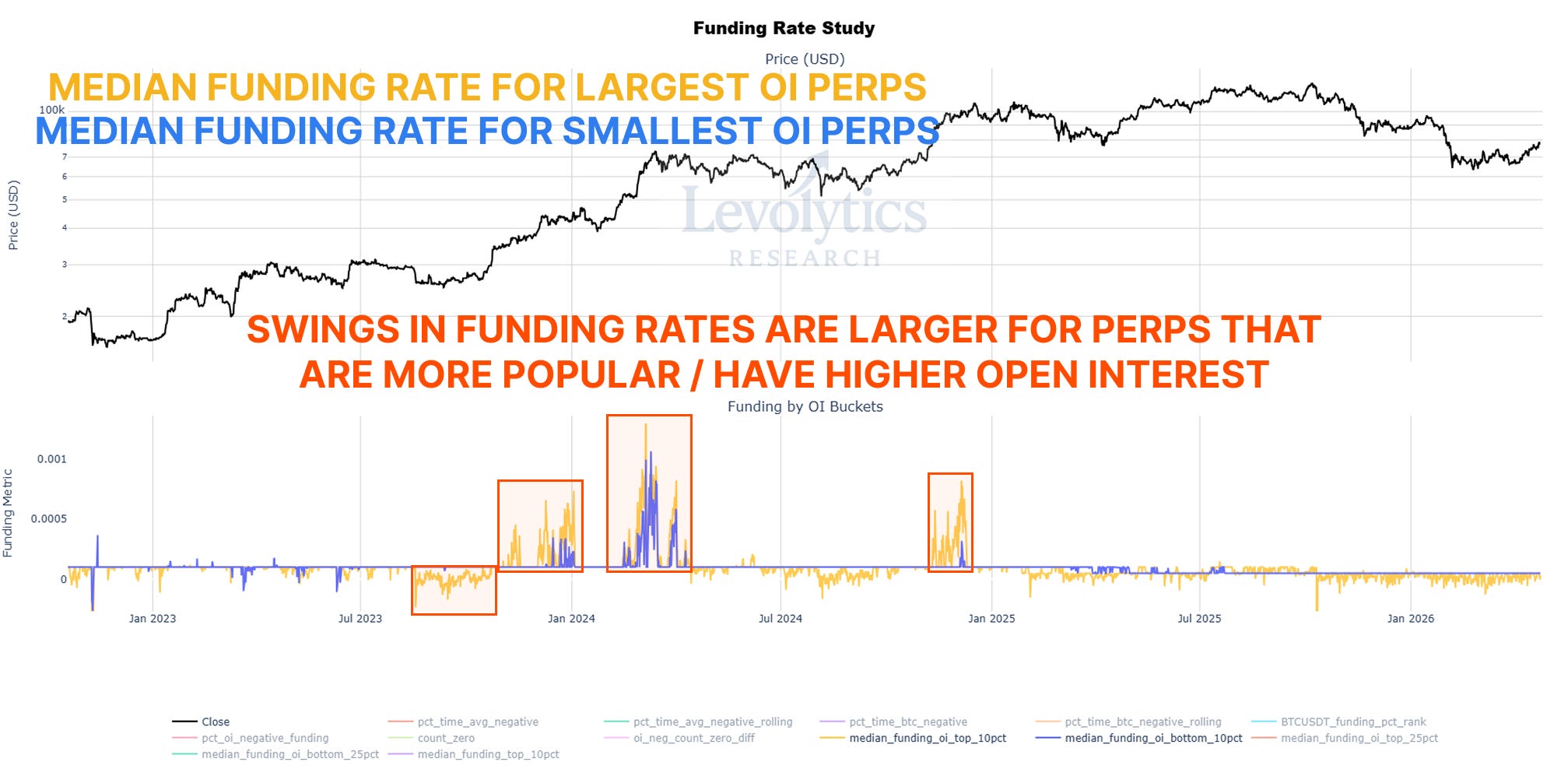
Prior to actually conducting this study, my expectation was that perpetual swap pairs with less open interest would have larger swings to the upside and downside in funding rates.
HOWEVER - that is not the case, with more popular pairs experiencing larger spikes in funding rates when the market gets overheated to the upside or downside.
This means that you’re likely paying more in funding for large / popular assets than you would be for any random shitcoin that happens to have a perpetual swap pair.
THE TIME
The average Crypto market participant likely understands this much about funding rates:
Negative funding rates = bearish
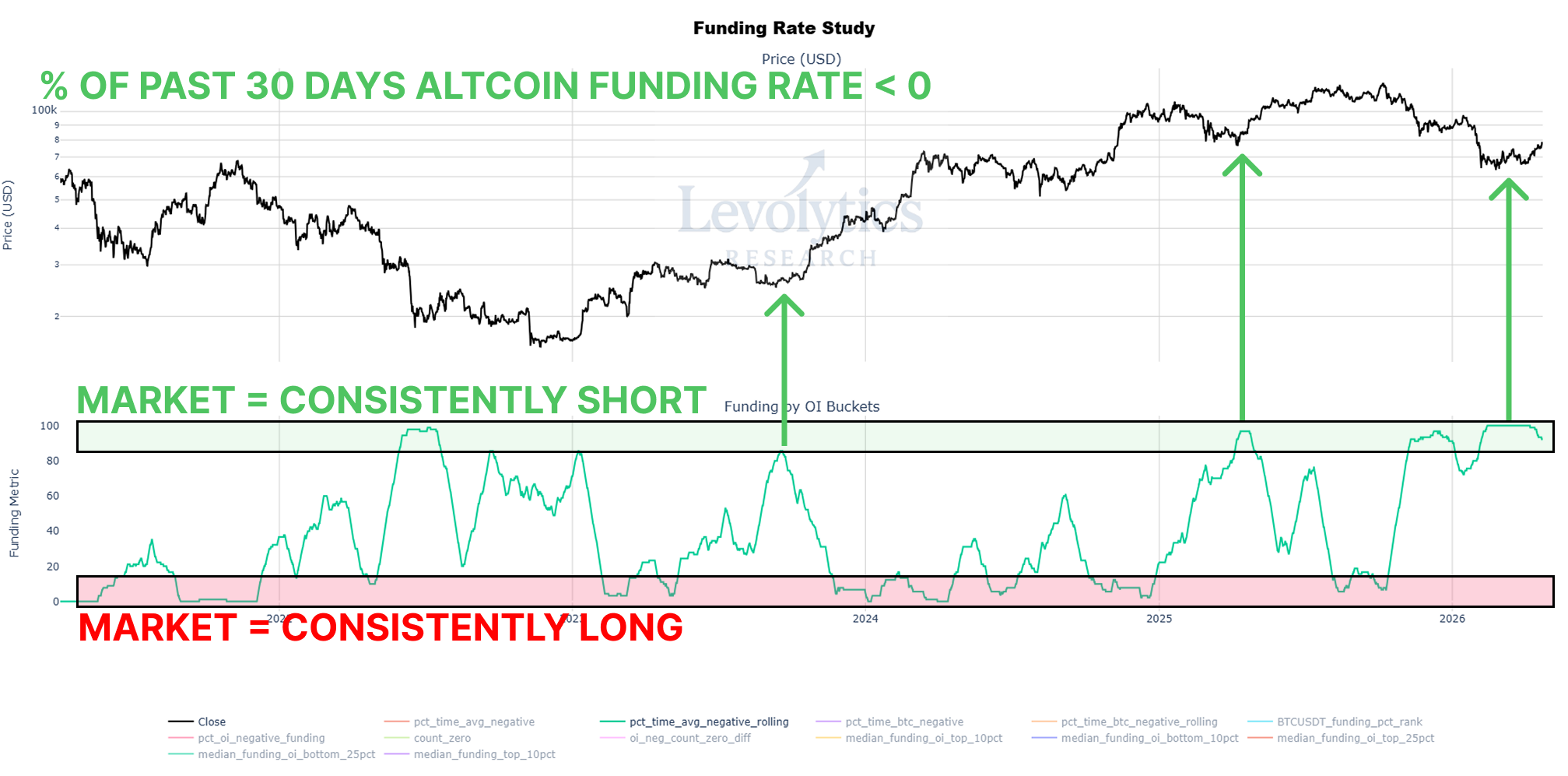
Simple as that. However - measuring the persistence of negative funding rates can be extremely useful in understanding the level of pessimism the market is feeling.
As such, we created a metric that measures the % of the past 30 days that altcoin funding rates have been negative.
Market bottoms and bear trends have a distinct marking of hitting values as high as 100% of days with negative funding rates.
Bull trends will consistently print values 20% or lower.
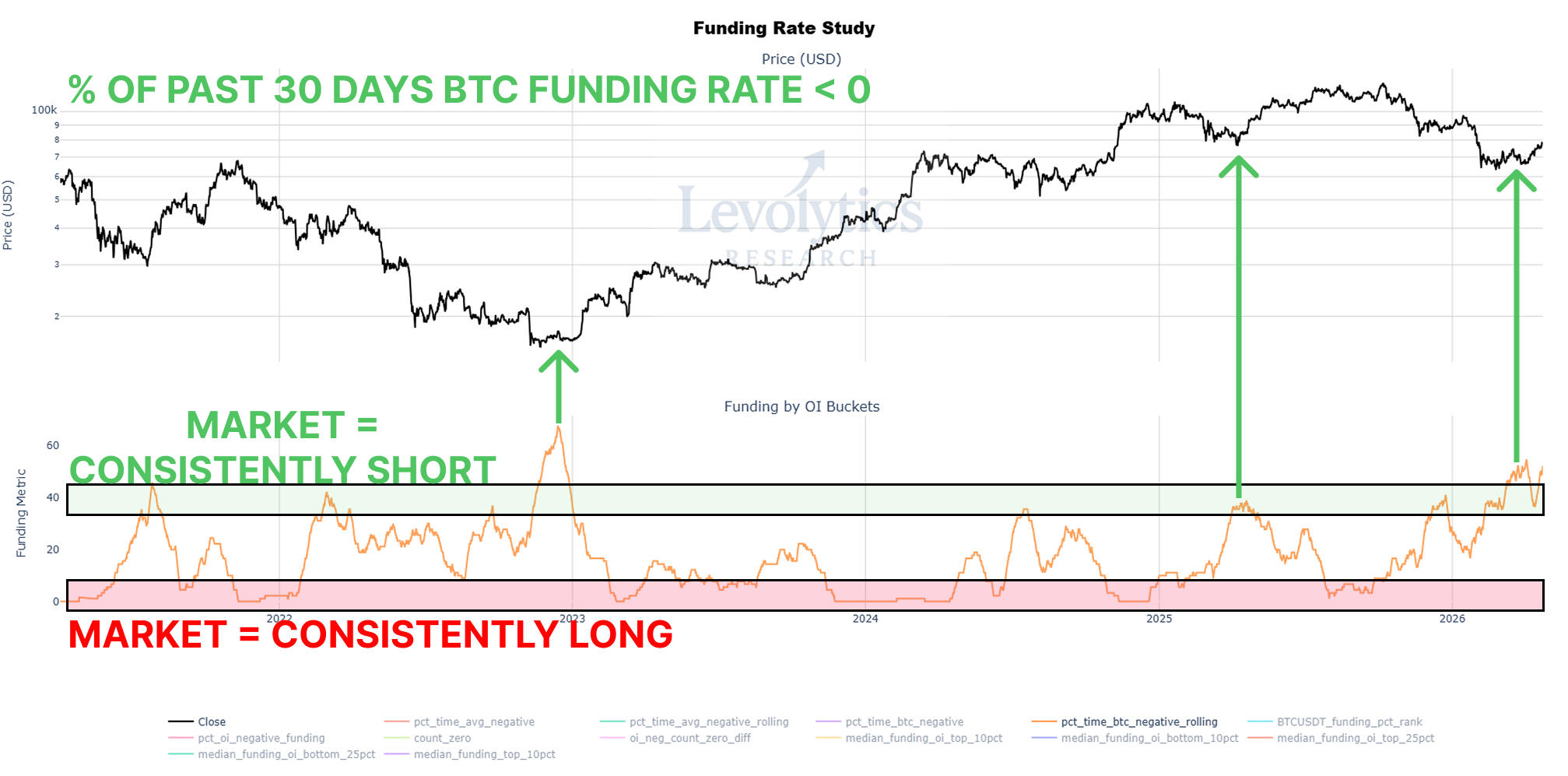
Here we have the same calculation for BTC. Note that you can perform this calculation for any perpetual swap pair you like too.
Values between 40% to 60% are the territory when BTC jumps into the “consistently shorted” category.
Current value = 52%
THE RANK
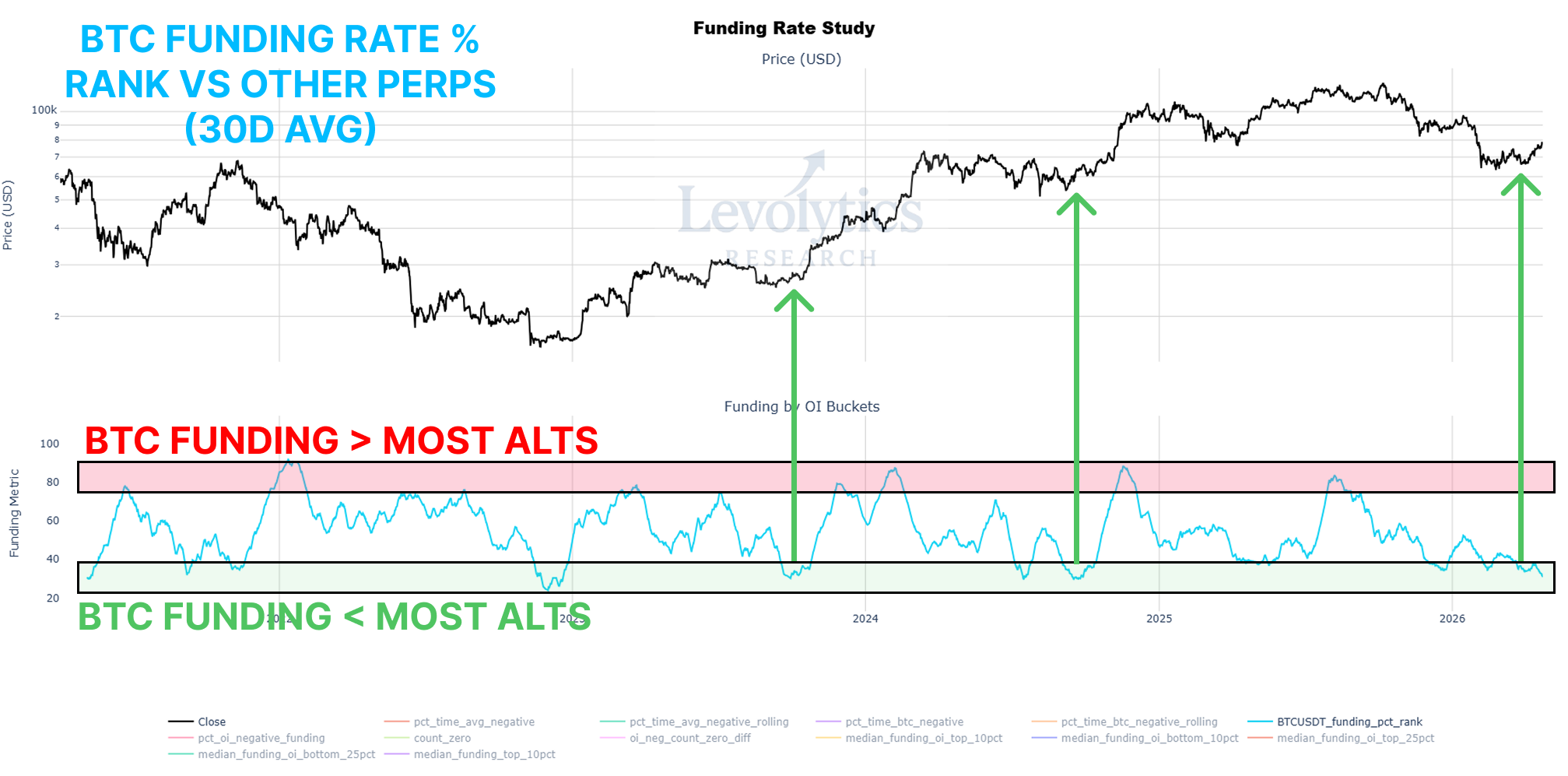
Remember that earlier on we discussed how more popular perps have wider swings in their funding rates.
BTC is no exception to this rule: in bull runs its funding rate will eclipse more than 80% of other perps.
In downturns, BTC’s funding rate % rank usually finds a bottom around 30% (i.e. 70% of perps have higher funding rate than BTC).
THE CLOSE
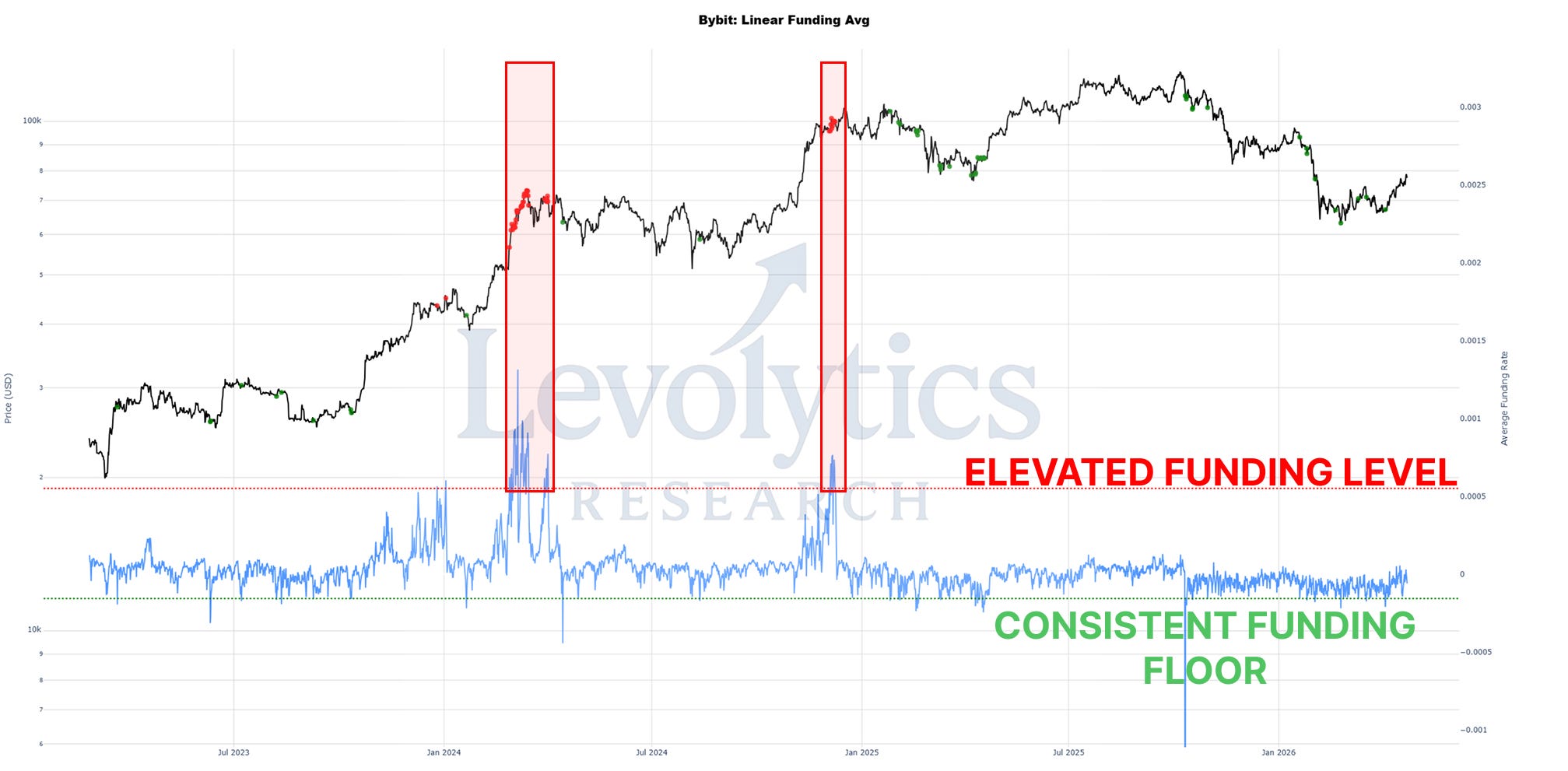
When in doubt, we can always fall back on the standard funding rate chart for alts as a whole (like the one above), BTC, or any other particular asset we like.
The signal isn’t as clear on a day to day basis, but the signs are there when the market is extremely overbought and levered to the gills.
As always, only complicate your analytics life as much as is actually necessary.
I believe there is still more to uncover here as it relates to perpetual swap funding rates, but we will leave things here for today.
Have a great weekend - welcome the pump into your life.
DISCLAIMER
The performance results presented herein reflect proprietary trading activity conducted with internal capital only. No external capital is managed, accepted, or solicited. These results are unaudited and are provided solely for informational and research purposes.
Performance data represents the return on internal capital based on realized and unrealized gains and losses, net of trading fees and transaction costs, but before any taxes or potential operating expenses. The methodology used to calculate performance has been applied consistently; however, results have not been verified by any independent party.
Past performance is not necessarily indicative of future results. All investments involve risk, including the potential loss of principal. The information contained herein does not constitute an offer to sell or a solicitation of an offer to buy any security, investment fund interest, or other financial instrument.
Any opinions, estimates, or forward-looking statements are subject to change without notice and are provided for illustrative or educational purposes only.